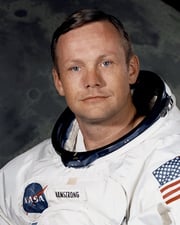
Neil Armstrong
First Human to Walk on the Moon
Why They Changed Society
Neil Armstrong's first step on the Moon was the culmination of humanity's oldest dream — to reach beyond our world. The Apollo 11 mission, watched by 600 million people worldwide, proved that human beings could travel to another celestial body and return safely. Beyond the technical achievement, the Moon landing unified humanity in a way few events ever have, transcending borders, politics, and conflict for one shared moment of wonder. It accelerated satellite technology, materials science, computing, and inspired generations of scientists and engineers. Armstrong's quiet courage and humility in the face of the greatest adventure in human history made him the perfect representative of our species on another world.
Impact by the Numbers
600 million
People Who Watched Live
47.5 lbs
Moon Rocks Collected
2.5 hours
Time on Moon Surface
Timeline
Selected by NASA as part of the second group of astronauts, beginning his journey to the Moon.
Commanded Gemini 8, performing the first successful docking of two spacecraft in orbit.
Became the first human to walk on the Moon during Apollo 11, spending 2.5 hours on the lunar surface.
Awarded the Presidential Medal of Freedom by President Nixon upon return from the Moon.
Key Contributions
First Moon Walk (1969)
Became the first human to set foot on another world, proving interplanetary travel is possible.
Gemini 8 Docking (1966)
Performed the first successful orbital docking, a critical technique for all future space missions.
Inspiring Space Exploration
His achievement inspired generations of scientists, engineers, and astronauts to push the boundaries of exploration.
Notable Quotes
“That's one small step for man, one giant leap for mankind.
— First words on the Moon, July 20, 1969
“Mystery creates wonder and wonder is the basis of man's desire to understand.
“I believe every human has a finite number of heartbeats. I don't intend to waste any of mine.