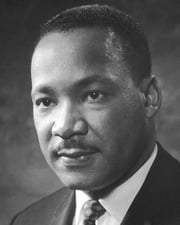
Martin Luther King Jr.
Leader of the American Civil Rights Movement
Why They Changed Society
Martin Luther King Jr. transformed the United States and inspired the world. Through nonviolent protest, moral courage, and extraordinary oratory, he led the movement that dismantled legal segregation in America, resulting in the Civil Rights Act of 1964 and the Voting Rights Act of 1965 — laws that fundamentally changed American society. His philosophy of nonviolent resistance, drawn from Gandhi and the Christian tradition, provided a moral framework adopted by liberation movements across the globe. His dream of a nation judged by character rather than color continues to challenge and inspire humanity to build a more just world.
Impact by the Numbers
250,000
March on Washington Crowd
35
Nobel Peace Prize Age
Timeline
Led the 381-day Montgomery Bus Boycott after Rosa Parks' arrest, ending bus segregation.
Delivered the iconic 'I Have a Dream' speech to 250,000 people at the March on Washington.
Awarded the Nobel Peace Prize at age 35, the youngest recipient at that time.
The Civil Rights Act of 1964 was signed, outlawing discrimination based on race, color, religion, sex, or national origin.
Key Contributions
Montgomery Bus Boycott (1955)
Led the successful boycott that ended racial segregation on public transit and launched the civil rights movement.
Civil Rights Act of 1964
His leadership was instrumental in passing the law that outlawed racial discrimination in public life.
Nonviolent Resistance Philosophy
Demonstrated that nonviolent moral protest can defeat institutionalized injustice, inspiring movements worldwide.
Notable Quotes
“I have a dream that my four little children will one day live in a nation where they will not be judged by the color of their skin but by the content of their character.
— March on Washington, 1963
“Injustice anywhere is a threat to justice everywhere.
— Letter from Birmingham Jail, 1963
“The arc of the moral universe is long, but it bends toward justice.