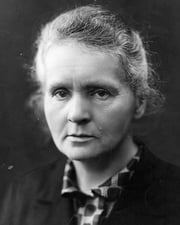
Marie Curie
Pioneer of Radioactivity Research
Why They Changed Society
Marie Curie's discoveries fundamentally changed humanity's understanding of matter itself. Her research on radioactivity — a term she coined — led to the discovery of two elements and opened the door to nuclear physics, cancer treatment, and atomic energy. She was the first woman to win a Nobel Prize, the first person to win two Nobel Prizes, and remains the only person to win in two different sciences. During World War I, she developed mobile X-ray units ('petites Curies') that saved countless soldiers' lives. She broke through barriers of gender discrimination in science that had stood for centuries, inspiring generations of women scientists worldwide.
Impact by the Numbers
2
Nobel Prizes Won
2
Elements Discovered
Timeline
Discovered two new elements — polonium (named after her homeland Poland) and radium.
Became the first woman to win a Nobel Prize, shared with Pierre Curie and Henri Becquerel.
Won a second Nobel Prize for her discovery of radium and polonium, the only person to win in two sciences.
Developed mobile radiography units for field hospitals during WWI, saving thousands of soldiers.
Key Contributions
Radioactivity Research
Coined the term 'radioactivity' and conducted pioneering research that opened the field of nuclear physics.
Discovery of Radium & Polonium (1898)
Discovered two new elements, fundamentally advancing chemistry and enabling radiation therapy for cancer.
Mobile X-Ray Units (1914)
Created portable X-ray machines for WWI battlefields, revolutionizing military medicine.
Notable Quotes
“Nothing in life is to be feared, it is only to be understood. Now is the time to understand more, so that we may fear less.
“I am among those who think that science has great beauty.
“Be less curious about people and more curious about ideas.